
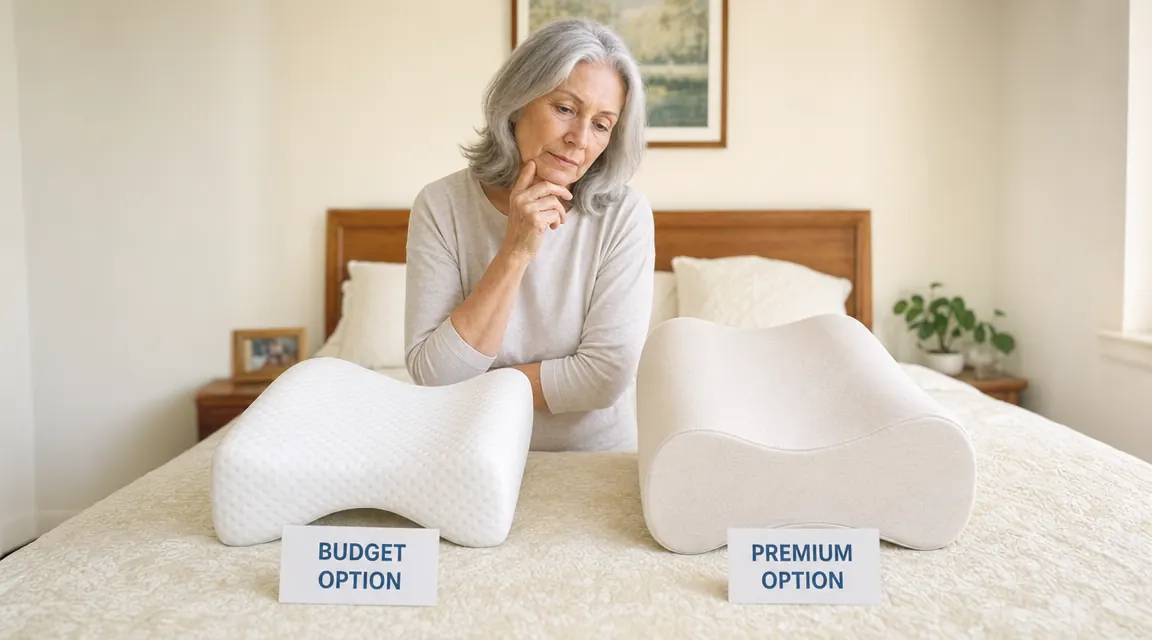
My hip started waking me up at 2 a.m. two winters ago. Not a sharp pain, just that dull, grinding ache that made it impossible to find a comfortable position on my left side. My grandsons Marcus and Eli were coming to stay for a week that spring, and I needed to be able to keep up with them. That meant sleeping, which meant fixing this hip business. A knee pillow kept coming up in my research, so I tried one. Then I tried another. The ComfiLife Orthopedic Knee Pillow and the Tempur-Pedic Knee Pillow ended up being the two I spent the most time with, and they are very different products despite doing the same basic job.
The short answer: the ComfiLife is my pick. It delivers most of the same relief at a fraction of the price. But I want to be fair to the Tempur-Pedic, because it is not a bad pillow. It just has to clear a much higher bar to justify its cost, and for most people it does not quite get there. Here is what I found.
| ComfiLife | Tempur-Pedic Knee Pillow | |
|---|---|---|
| Price | Check today's price on Amazon | Mid-range |
| Material | Standard memory foam, medium density | Tempur proprietary foam, denser feel |
| Shape | Hourglass contour, ergonomic cutout | Contoured hourglass, thinner profile |
| Cover | Removable, washable velour cover | Non-removable cover (spot clean only) |
| Strap | Adjustable leg strap included | No strap |
| Weight | Lighter, easier to reposition at night | Heavier, stays in place more firmly |
| Amazon Reviews | 30,500+ reviews, 4.2 stars | Limited Amazon presence |
| Washability | Machine-wash the cover | Spot clean only |
Where the ComfiLife Wins
The most obvious win is price, and I do not want to gloss over that just because it feels like an obvious point. The ComfiLife costs roughly one-quarter what you will spend on the Tempur-Pedic. That matters on a fixed income. But price alone would not make it my recommendation if the pillow did not perform, so let me tell you what actually works about it.
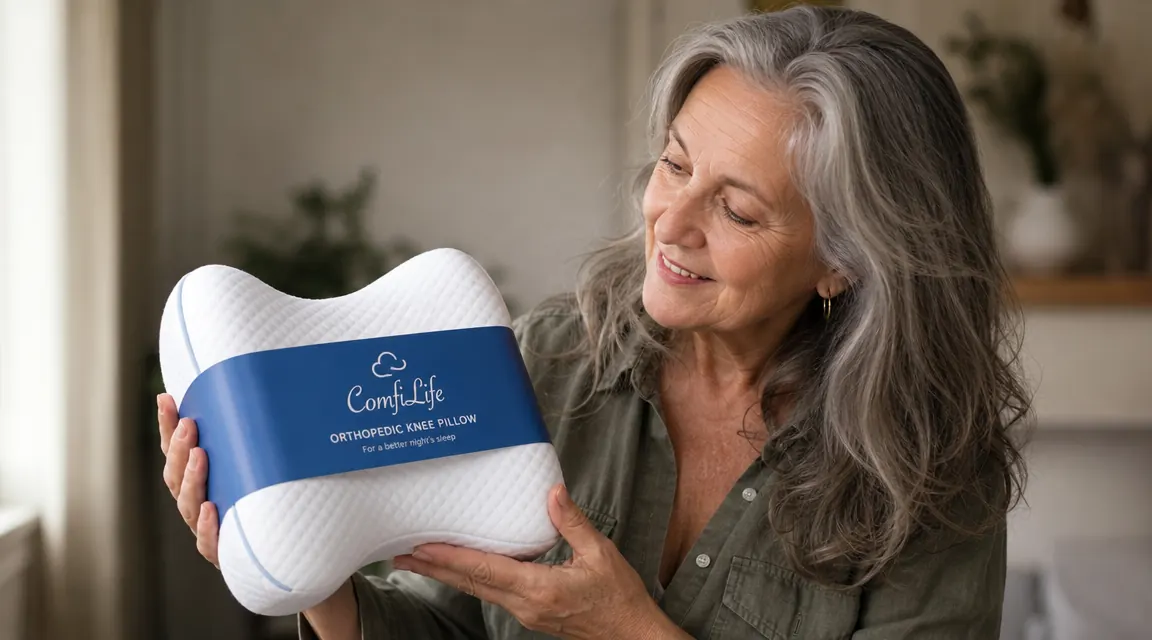
The hourglass shape is well-designed. It holds between your knees without you having to clamp down on it, and the cutout in the middle gives your legs a natural resting position that keeps your hips stacked. I noticed a real difference in my hip pain within the first three nights. The ache that was waking me at 2 a.m. was gone by night four. Now, I cannot promise that happens for everyone, but the design logic is sound: when your hips are misaligned overnight, you get pain. Keep them level, and the pain often goes away.
The removable washable cover is also something I appreciate more than I expected to. I run warm at night, and over a week the cover picks up sweat and body heat. Being able to pull it off and toss it in the wash on Sundays keeps things fresh. With the Tempur-Pedic, you are stuck spot-cleaning, which is not the same thing. The adjustable strap that holds the pillow in place on one leg is another practical detail the Tempur-Pedic lacks. I do not always use the strap, but on nights when I toss a lot it prevents me from kicking the pillow off the bed at 3 a.m.
Where the Tempur-Pedic Wins
The Tempur-Pedic foam is genuinely different. It is denser and slower to recover, which means it conforms to the exact shape of your legs without any springback. If you are someone who finds that standard memory foam feels a little bouncy or not quite substantial enough, the Tempur foam may feel more satisfying under your knees. For heavier legs or people who need firm, unyielding support, this density could matter.
It also holds its shape through the night without flattening as much. The ComfiLife will gradually compress over several months of use, and you will notice it is not quite as thick as it was when new. The Tempur foam holds up longer before that happens. So if you are thinking about a five-year timeline, the longevity math might look a little different, though you are still spending four times more to start.
If your hip or knee pain is keeping you up, the ComfiLife is where I would start.
It costs a fraction of the Tempur-Pedic, has a washable cover, includes a leg strap, and has over 30,000 Amazon reviews from real side sleepers. I have been using mine for months and it is still on my bed every night.
Amazon Check Today's Price on Amazon →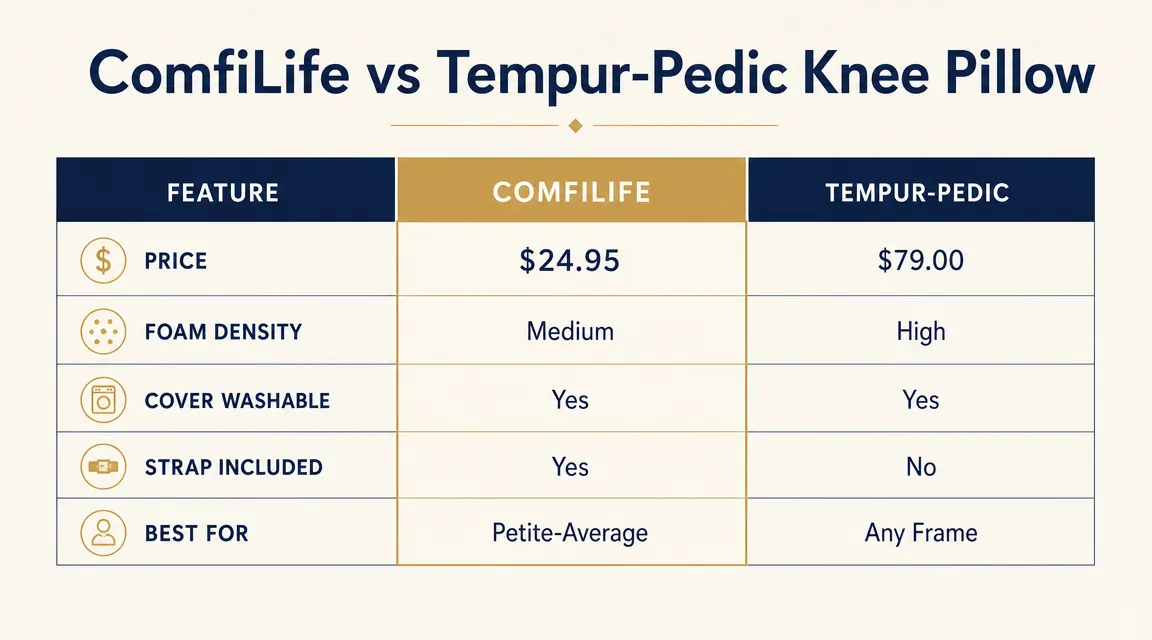
How I Actually Tested These
I spent three weeks with each pillow, alternating them so I was not just comparing memory to memory. I sleep on my left side almost exclusively, and my main complaint was hip pain that would start around 2 a.m. and make it hard to fall back asleep. I tracked how many nights I woke with pain, how long it took me to fall asleep, and whether I felt rested when my grandsons came bounding in at 6:30 in the morning.
I also paid attention to practical details, because at 68 I care about things like whether I can actually wash the thing, whether I have to wake up fully to reposition it, and whether the cover is soft enough that it does not irritate the skin on my knees overnight. These are real-life considerations that get left out of most product reviews written by people who are not actually sleeping with these things every night.
The Tempur-Pedic foam is lovely. But at four times the cost, with a cover you cannot wash, it never quite made sense for my bedroom. The ComfiLife just works, night after night.
The Foam Question: Does Premium Foam Actually Matter Here?
This is the heart of the debate. Tempur-Pedic built their reputation on proprietary foam that genuinely performs differently from generic memory foam. In a mattress, that difference can be meaningful because you are spending eight hours in contact with it, and even small variations in pressure distribution add up. In a knee pillow, I am less convinced the gap is as large.
A knee pillow is doing a simple job: keeping your knees from pressing together and keeping your hips aligned. It does not need to handle the full weight of your body the way a mattress does. The ComfiLife foam is firm enough to maintain that spacing without bottoming out, which is really the only thing you need it to do. If you already own Tempur-Pedic products and love the feel of their foam, you may prefer the pillow for purely tactile reasons. That is legitimate. But if you are starting from scratch and just need the pain to stop, the premium foam is not buying you much.
A Note on the Strap
Nobody talks about the strap enough. The ComfiLife comes with an adjustable velcro strap that wraps around one leg and keeps the pillow anchored. The first time I used it I thought it seemed fussy and unnecessary. Then I had a restless night, woke up at 4 a.m., and the pillow was exactly where I left it. The Tempur-Pedic has no strap. If you are a still sleeper this may not matter to you. If you move around, you will end up fishing the pillow off the floor in the middle of the night, which is not a peaceful experience.

Who Should Buy Which
Buy the ComfiLife if you are a side sleeper with hip, knee, or lower back pain, you want something you can wash regularly, you want a strap to keep it in place, and you do not want to spend a premium to find out if a knee pillow even helps you. That describes most people reading this. Over 30,000 Amazon reviewers have been in the same spot, and the 4.2-star average holds up across a huge range of body types, sleep positions, and pain complaints. I trust that number.
Consider the Tempur-Pedic if you have already tried a standard memory-foam knee pillow and found it did not hold up well over time, or if you have heavier legs and need a denser foam that does not compress as quickly. You might also prefer it if you are a brand loyalist who already sleeps on Tempur-Pedic products and wants the ecosystem to match. There is nothing wrong with any of those reasons. Just go in knowing the cover is not removable, there is no strap, and you are paying significantly more for foam that, in this particular application, does not do a dramatically different job.
The ComfiLife is the one still on my bed. Here is where to find it.
If you are tired of waking up with hip or knee pain and you have not tried a knee pillow yet, the ComfiLife is a low-risk place to start. The price is reasonable, it washes easily, and it has a proper strap to keep it where you put it. My hip pain dropped significantly within the first week.
Amazon Check Today's Price on Amazon →