

When I first started having trouble sleeping through the night, my daughter handed me a bottle of melatonin from her medicine cabinet and said, 'Just try this, Mom.' I did try it. And for about two nights it seemed to help a little. Then it stopped doing much at all, and I was right back to lying there at 2 a.m. watching the ceiling fan. What she did not tell me, because she did not know either, was that melatonin and magnesium glycinate are completely different things. One of them I now take every single night. The other I stopped using after about three weeks.
I want to be straightforward: I am not a doctor, and nothing here is medical advice. What I can tell you is how these two supplements worked for me personally, and how they are different in ways that matter if you are a light sleeper who wakes up at odd hours. If you are considering either one, please talk to your own doctor first, especially if you are on any medications.
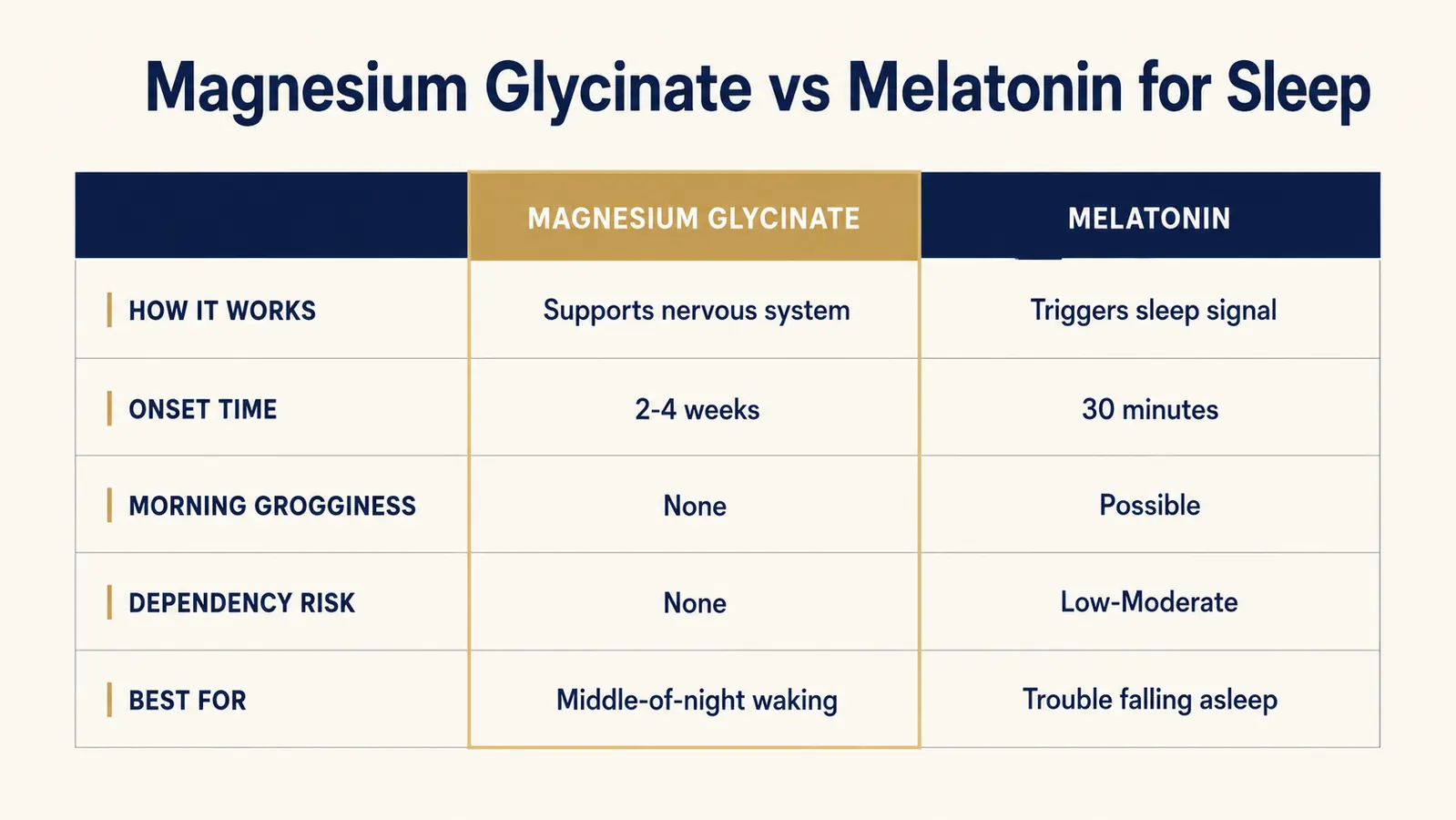
| Feature | Magnesium Glycinate | Melatonin |
|---|---|---|
| What it is | Essential mineral bound to glycine amino acid | Hormone your body already produces naturally |
| How it works | Supports nervous system calm and muscle relaxation | Signals the brain that it is time to sleep |
| Best for | People who wake in the night or feel wired at bedtime | Shifting sleep timing, jet lag, or occasional sleeplessness |
| Onset | Gradual over days to weeks with consistent use | Faster, often within 30 to 60 minutes of taking it |
| Dependency risk | Low; it is a mineral your body needs regardless | Some people find it less effective over time |
| Morning grogginess | Rarely reported at standard doses | Sometimes called the 'melatonin hangover' at higher doses |
| Supplement form | Capsule or tablet, taken with water | Capsule, gummy, or fast-dissolve tablet |
| Typical price range | Around two to three cents per serving | Similar, varies widely by dose |
What Is the Real Difference Between These Two?
Melatonin is a hormone. Your brain makes it naturally when the sky gets dark, and it tells your body that sleep time is coming. When you take melatonin as a supplement, you are essentially adding to what your body already produces. This is why it works well for situations where your sleep timing is off, like traveling across time zones or adjusting to a new work schedule. It nudges the clock.
Magnesium glycinate is something different entirely. Magnesium is a mineral your body needs for hundreds of processes, including keeping your nervous system from staying in a high-alert state. The glycinate form is paired with an amino acid called glycine, which has its own calming properties. Many adults are low in magnesium without realizing it, partly because of diet and partly because stress depletes it faster. When I started taking it, I did not fall asleep faster overnight. What changed, slowly, over about two weeks, was that I stopped waking up at 2 a.m. with my mind already racing.
That difference matters. If your problem is getting to sleep in the first place, melatonin may be more immediately helpful. If your problem is staying asleep, or feeling tense and wired at bedtime even when you are tired, magnesium glycinate is worth a closer look.
If waking up at 2 a.m. is your problem, this is what I use every night.
Doctor's Best High Absorption Magnesium Glycinate is the one I landed on after trying two other forms of magnesium first. It has over 75,000 Amazon reviews and a 4.6-star rating. The tablet is plain, easy to swallow, and the price per serving is genuinely low.
Amazon Check Today's Price on Amazon →
Where Magnesium Glycinate Wins
The biggest advantage of magnesium glycinate for sleep is that it addresses something structural. If your nervous system is stuck in a half-alert state at night, melatonin does not fix that. It just signals that it is time to sleep while your body is still braced for something. Magnesium, when you are genuinely low on it, helps your muscles relax, quiets nerve activity, and supports the production of GABA, which is a calming neurotransmitter. The result for me was a kind of deeper rest that I had not had in months.
The glycinate form in particular is chosen for sleep because glycine on its own has been studied for its ability to lower core body temperature slightly at night, which is part of what the body does naturally when entering deep sleep. Doctor's Best uses a TRAACS-chelated form of magnesium glycinate, meaning the mineral is bound in a way that is easier for the body to absorb than cheaper oxide forms. I noticed fewer digestive complaints with this form than with magnesium citrate, which I had tried first and which was a bit too much for my stomach.
There is also no morning grogginess with magnesium glycinate at normal doses. That alone made it preferable to me. I have grandchildren to get up for. I cannot afford to feel foggy until ten in the morning.
Two weeks in, I stopped waking at 2 a.m. I had not had an uninterrupted night in almost a year before that.
Where Melatonin Wins
Melatonin is faster. If you need to fall asleep at an unusual hour, or you are jet-lagged, or you are dealing with a temporary stretch of insomnia and you need something to work tonight, melatonin has an advantage. It acts relatively quickly, typically within 30 to 60 minutes for most people, and the effect is noticeable in a way that magnesium glycinate is not on day one.
Melatonin is also very well studied and widely used. The research on low doses, in the 0.5 to 1 mg range, is generally positive for sleep onset. Where people sometimes run into trouble is by taking doses that are far higher than necessary. Many gummies and chewables sold in stores contain 5 mg, 10 mg, or even more, which is many times what the body uses naturally. Higher doses tend to produce that groggy, foggy-headed feeling the next morning. If you use melatonin, a lower dose is usually more effective than a higher one, counterintuitive as that sounds.
The Dependency Question
One thing I worried about before switching was whether I would become reliant on a supplement to sleep. It is worth addressing directly. Magnesium is a mineral your body needs to function regardless of whether you take it as a supplement. If you are deficient, supplementing brings you toward a baseline your body wants to be at. When people stop taking magnesium glycinate, they do not typically experience withdrawal or rebound wakefulness.
Melatonin is a bit more nuanced. It is not habit-forming in the way that prescription sleep aids can be, but some people do find that after regular use their natural melatonin production adjusts, making it harder to sleep without the supplement. The research on this is mixed, and many people take melatonin occasionally without any issues. But if you are looking for something you can take nightly without concern, magnesium glycinate tends to be the safer long-term choice from a dependency standpoint. Your doctor can give you more specific guidance based on your own health situation.
A Note on the Doctor's Best Formula Specifically
When I looked at magnesium glycinate options on Amazon, there were dozens. I tried two others before settling on Doctor's Best. The reason I landed here is straightforward: 75,000 reviews is not a number you get from a niche product that nobody actually uses. The 4.6-star average across that volume of feedback is meaningful. Plenty of those reviews are from other older adults who mention sleep as the reason they started taking it.
The tablets are plain white, easy to swallow, and contain 100 mg of elemental magnesium per tablet. The standard recommended serving is two tablets, giving 200 mg of elemental magnesium. Some people find that one tablet is sufficient, especially if they are sensitive to supplements. I take two, about 45 minutes before I plan to turn the light off. The cost per serving at two tablets is very low depending on the size bottle you order, which makes this one of the most affordable supplements I have added to my routine.
What I cannot promise is that it will work for you the way it worked for me. Supplements affect people differently, and whether you are actually low in magnesium makes a difference in how noticeable the effect will be. What I can say is that for a nightly supplement taken consistently, the Doctor's Best formula is well-made and the value is hard to beat. As always, check with your doctor before starting any supplement, particularly if you have kidney issues, as magnesium is processed by the kidneys.

Who Should Try Magnesium Glycinate First
If you wake up in the middle of the night and cannot get back to sleep, that points more toward magnesium glycinate than melatonin. The same is true if you feel tense or physically restless at bedtime even when you are genuinely tired. If you experience leg cramps at night, which some older adults do, magnesium glycinate may help with that too, since magnesium plays a role in muscle function. Anyone who has tried melatonin and found it either did not help or left them groggy the next morning is a good candidate to try magnesium glycinate instead.
Who Should Stick With Melatonin
If your sleep problem is situational, jet lag from a trip, an unusual work schedule, an occasional night of racing thoughts before a big day, melatonin is a reasonable short-term tool. It is also worth trying if the speed of onset matters to you and you would rather feel something working the first night. Just keep the dose low and do not rely on it nightly if you can help it.
Some people find that using both works well in combination, magnesium glycinate nightly for baseline support and melatonin occasionally on harder nights. If you go that route, it is worth mentioning to your doctor so they have a complete picture of what you are taking.
The one I kept. Simple ingredients, 75,000 reviews, and pennies a night.
Doctor's Best High Absorption Magnesium Glycinate Lysinate uses a chelated form for better absorption. I have taken it every night for six months and still recommend it without hesitation. Check the current price on Amazon and see if there is a Subscribe and Save option, which cuts the cost down further.
Amazon Check Today's Price on Amazon →Disclosure: This site earns a commission from Amazon on qualifying purchases at no extra cost to you. Supplement content here is informational only and does not constitute medical advice. Consult your doctor before starting any new supplement.