
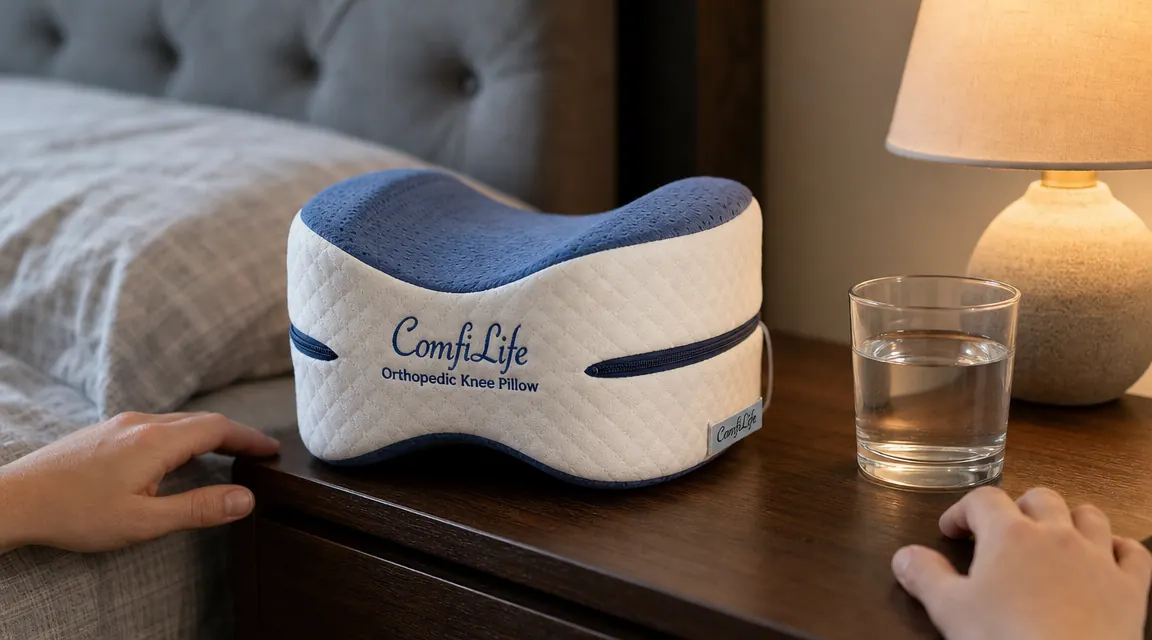
Let me tell you what the product listing does not say. The ComfiLife knee pillow has over thirty thousand ratings on Amazon and sits at 4.2 stars. That sounds like a settled question. Buy the thing, sleep better, done. But I have talked to enough friends at my church group who tried it and returned it within a week to know that those stars hide real differences in who this pillow actually fits. I am Minia, 67 years old, a side sleeper with mild hip and lower-back stiffness. I have been sleeping with this pillow for months. I want to tell you the things the marketing skips.
This is not a story about four months of pain tracking or gradual improvement curves. That kind of review exists already, and it tells one part of the truth. This is the other part: the quirks, the surprises, the things that catch you off guard in week one, and the clear profile of the person who should look at a different product entirely. If you are about to spend your money, you deserve the honest version.
The Quick Verdict
The ComfiLife works well for petite-to-average side sleepers who run cool and do not move much at night. It has real quirks around foam warmth, strap slippage, and size fit that the product page glosses over entirely.
Amazon Check Today's Price →Still reading? Most people who find this pillow genuinely helpful are side sleepers under 160 lbs. Check if it is right for you.
The ComfiLife knee pillow is budget-friendly. If you fit the profile, it is one of the best-value sleep fixes available. If you are on the fence after reading this, the comparison article at the end will help you decide.
Amazon Check Today's Price on Amazon →How I Actually Tested This
I sleep on my left side almost every night. I am five feet four inches tall and weigh about 138 pounds, so I am firmly in the petite-to-average category. My bedroom runs warm in summer, closer to 72 degrees, and I use a ceiling fan. I want to be upfront about that because body type and room temperature turned out to matter more than I expected when it comes to this pillow.
I did not track a pain score this time. Instead I paid attention to the things that surprised me: the first night feel versus the third week feel, whether the cover stayed put, how the foam handled warm nights, and what happened when I tried to sleep on my back with it. I also asked two friends to try it for a week each, one who is heavier-framed and one who tends to flip around at night. Their experiences added angles I could not get on my own.
I also checked the one-star and two-star reviews on Amazon, all of them, because that is where the real information hides. The complaints are almost never about the product being defective. They are about mismatched expectations, which tells you something important about how the product is marketed.
Surprise One: The Foam Is Warmer Than You Expect
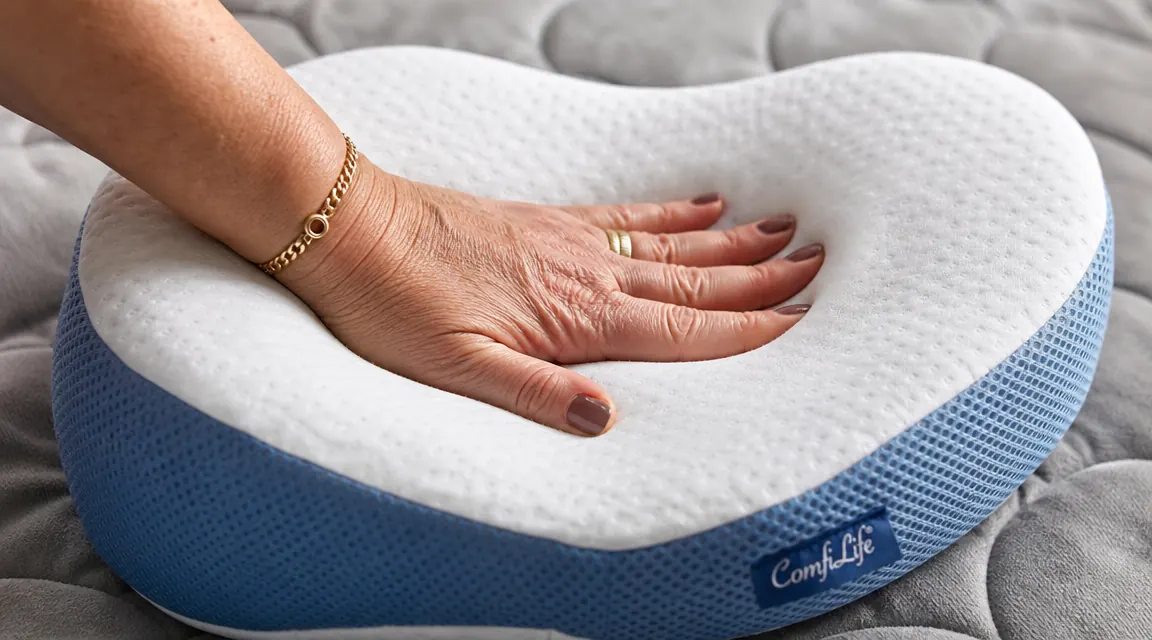
The product page shows a cool-looking white pillow in a breezy bedroom and says nothing about heat. Memory foam traps warmth. That is just physics. For me in cooler months, with the fan on, it was fine. In July, when my bedroom climbed to 73 or 74 degrees, I noticed the foam holding heat against my inner thighs and knees after about two hours. It was not unbearable, but it was noticeable enough that I would shift and lose my position.
My friend Patricia, who is a genuinely warm sleeper, tried it for four nights and gave up. She said it felt like sleeping with a heating pad between her legs. Her words, not mine. If you sleep hot, run warm, or if your bedroom sits above 70 degrees at night, this is information you need before you order. The listing mentions memory foam and nothing else. No mention of heat retention.
The fix, if you want to try it anyway, is to run the ceiling fan, use a cotton pillowcase over the cover (yes, it fits), or simply accept that you may need to remove the pillow for the second half of the night in warm months. I do this in summer. It still helps.
Surprise Two: The Strap Is a Suggestion, Not a Lock
The ComfiLife comes with a fabric strap that is supposed to loop around your leg and keep the pillow in place while you sleep. The product photos make it look secure, like a little seat belt for your knee pillow. In practice, the strap does very little for anyone who moves at all during the night.
I am a fairly still sleeper and the strap mostly kept up with me. But my other friend, Carol, who rolls from side to side several times a night, woke up every morning with the pillow on the bed somewhere to her left, completely disconnected from her body. She called it a knee pillow that had abandoned its post. Carol sleeps on both sides and naturally rolls. If that is you, the strap will not save you. The pillow works by staying between your knees through gravity and body position. The moment you roll or shift in a big way, it goes wherever it goes.
The strap is a nice idea. But if you move around at night, expect to find the pillow somewhere near your feet by morning.
This is not a manufacturing defect. It is simply what foam wedge pillows do. Competing products have the same limitation. The difference is that some of them are honest about it in the description. This one is not. If you are a restless sleeper or a bed rotator, any knee pillow is going to frustrate you until you accept that it is more of a positional aid for the first hour or two than an all-night solution.
Surprise Three: Body Size Changes Everything
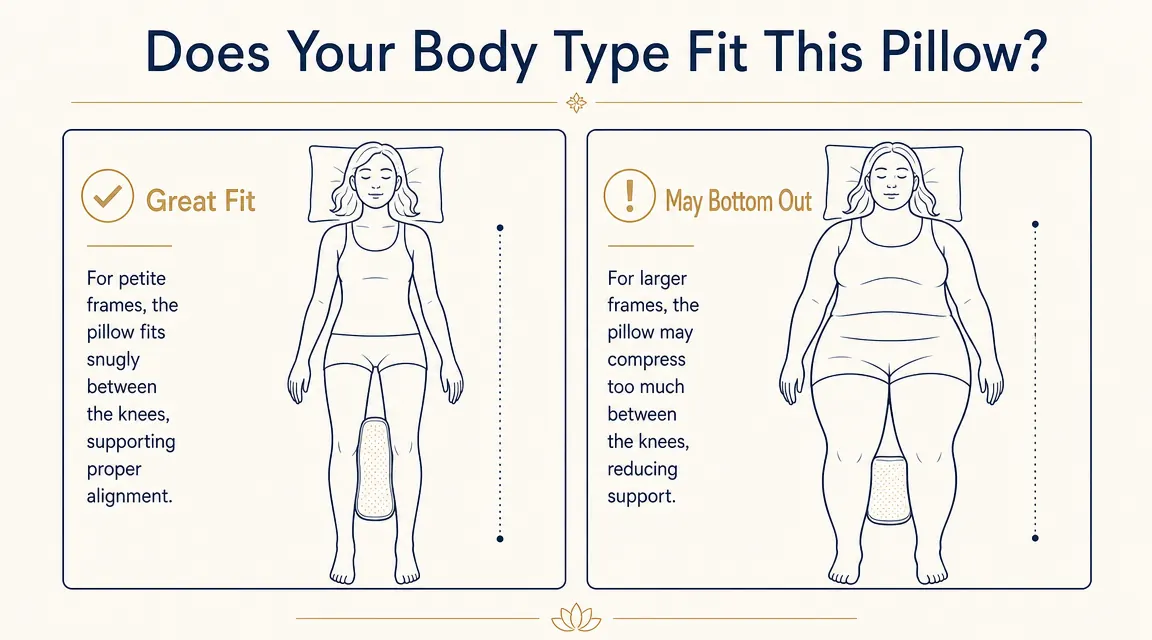
The ComfiLife is shaped like an hourglass with a standard width across the middle. For someone my size, that width sits right between my knees with a bit of give. It holds my legs at a comfortable distance and does not feel forced. The foam is firm but has enough give to settle in.
Here is what I found in the one-star reviews: people with larger frames, wider thighs, or longer legs frequently report that the pillow either bottoms out or sits at an awkward angle that puts pressure on the outside of the knee rather than cradling it. The foam has limits. If you are carrying more weight through your hips and thighs, the memory foam compresses past its useful range and you essentially end up with a thin foam layer rather than a supportive wedge. Several reviewers mention this directly, and not one of the product images shows a person over 160 pounds using it.
This is not a knock on the product for what it is. It is a knock on the marketing for not saying it. If you are petite to average in frame, this pillow likely fits beautifully. If you are above average in size, look at the Everlasting Comfort knee pillow, which uses a denser foam with a wider profile and tends to hold its shape better under more weight. The ComfiLife comparison article linked at the bottom of this page covers that option in detail.
Surprise Four: It Does Almost Nothing for Back Sleepers
The listing says it is good for back sleepers too, with the pillow placed under the knees. I tried this. I slept with it under both knees for two nights, the way you sometimes see in physical therapy photos. It did reduce some of the lower-back pressure I occasionally feel when I am on my back. But it is awkward to maintain. The pillow wants to slide, your legs shift, and within an hour it has migrated out from under you.
A traditional cylindrical bolster pillow does a far better job for back sleepers because it stays in place across the full width of the leg. The ComfiLife is genuinely designed for side sleeping. The back-sleeper claim on the packaging feels like a marketing add-on. Do not buy this if back sleeping is your primary position. Buy it if you are a side sleeper. That is where it earns its stars.
What the Cover Situation Actually Looks Like
The pillow comes with a zippered velvet cover. It is soft, washable, and easy to remove. That part is genuinely good. But the velvet, while comfortable, grabs onto sheets. If you are a restless sleeper this works against you because the cover clings to the fabric beneath you rather than sliding with your movement. For still sleepers like me, the grip is actually welcome because it helps the pillow stay roughly in position.
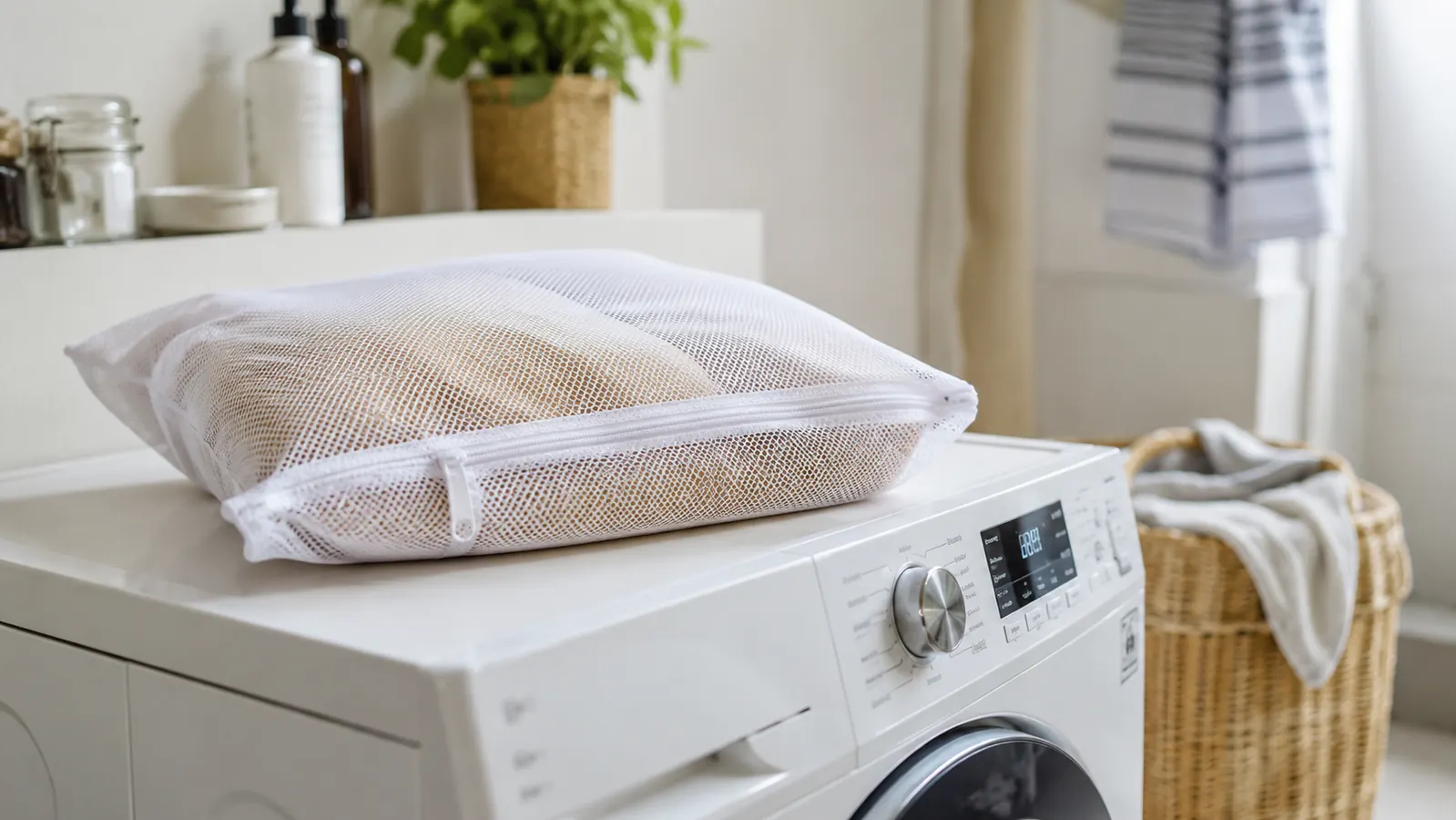
Washing the cover weekly is easy. Unzip, toss it in a mesh bag, run it on gentle, hang dry. It takes about five minutes of effort. The foam core itself is not washable, which is standard for memory foam. If anything ever gets on the foam, spot clean with a damp cloth and let it air dry completely before replacing the cover. I have had no issues in months, but that is worth knowing going in.
What I Liked
- Genuine hip and knee relief for side sleepers in the petite-to-average frame range
- Budget-friendly, which is about the lowest you can pay for a legitimate orthopedic knee pillow
- Washable velvet cover is soft and easy to remove
- Hourglass shape cradles knees without you needing to actively hold it in place
- 30,535 reviews means the quality is consistent, no lottery on a bad batch
Where It Falls Short
- Memory foam retains heat, noticeable for warm sleepers or in rooms above 70 degrees
- Strap does not reliably hold the pillow through significant nighttime movement
- Foam may bottom out under heavier body frames, reducing its support value
- Back-sleeper claim on the packaging is overstated, not well-suited for that position
- Cover velvet clings to sheets, which slows positional shifts for restless sleepers
The Honest Word on Those 30,000 Reviews
Thirty thousand reviews and a 4.2 rating sounds decisive. And it mostly is: this product is not a gimmick, it is not cheaply made, and it genuinely helps a specific kind of person sleep better. But a 4.2 star average hides the spread. About nine percent of reviewers gave it one or two stars. At thirty thousand reviews, that is roughly two thousand seven hundred people who were disappointed. The pattern in those low reviews is consistent: too hot, pillow migrates, does not fit my body type. Not defective. Mismatched.
The happy 4- and 5-star reviewers tend to be petite women, side sleepers, people with hip or sciatic pain, and people who sleep in cooler rooms. If you read their testimonials, you will see your own situation reflected if you belong to that group. If you do not, you will see the disconnect. This review is trying to bridge that gap before you spend any money.
Who This Is For
You will likely love this pillow if you are a side sleeper, petite to average in frame, sleep in a cool room or use a fan, and do not rotate significantly through the night. If your main problem is hip pressure, lower back stiffness, or knee-on-knee discomfort, this pillow addresses all three in a direct, inexpensive way. It is not complicated and it does not require any adjustment period beyond two or three nights to find your preferred position.
Who Should Skip It
Skip this one if you run hot at night, sleep in a warm room, have a heavier build, rotate between sides and your back, or need a back-sleeping support pillow. For warm sleepers who still want a knee pillow, look for options with cooling gel memory foam layers. For heavier frames, the denser foam options hold up better over time. For back sleepers, a simple bolster or half-moon pillow under the knees will stay put far better than any hourglass wedge design. And if you want a full side-by-side comparison of this pillow against the Tempur-Pedic option, my comparison article covers that directly.
If the petite-to-average side-sleeper description fits you, this is one of the best investments you can make in your sleep.
The ComfiLife knee pillow is widely available and ships quickly. Check today's price on Amazon and read the recent reviews to see if others with your body type are reporting good results.
Amazon Check Today's Price on Amazon →