
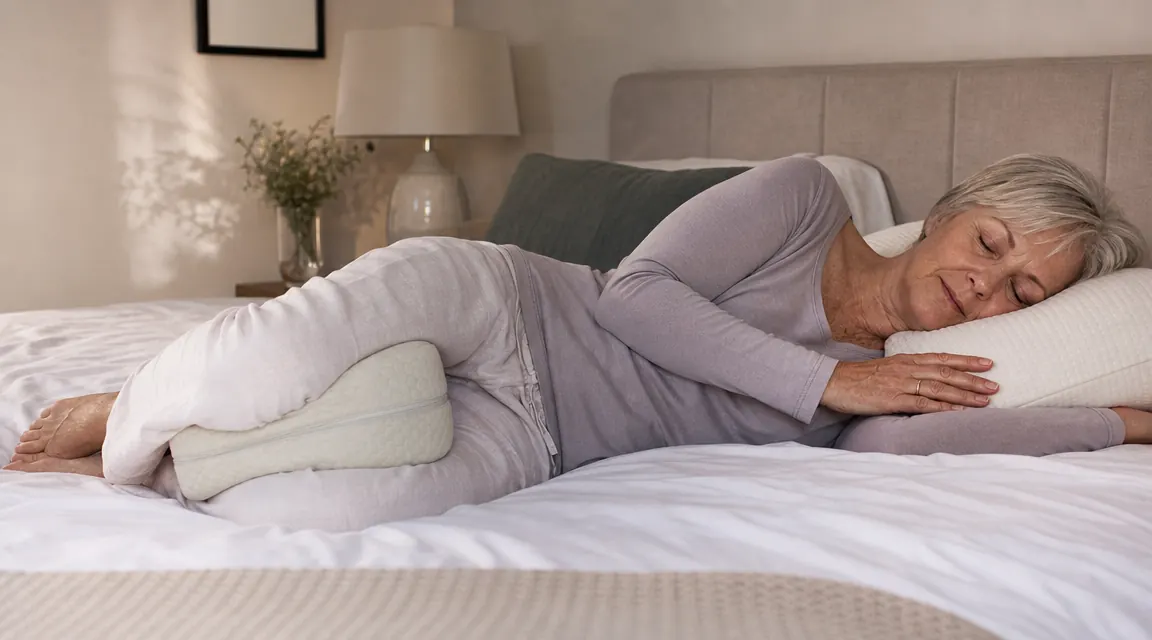
I have been a side sleeper my whole life. My doctor has always said that is fine, even good for circulation and your lower back. But for the last few years I started waking up with a dull ache in my knees and a sharp pinch along my right hip that would not quit until I had been up and moving for a good twenty minutes. I am 67, and I babysit my two grandsons three days a week. Shuffling around stiff until ten in the morning was not working for me. I needed to fix this, and I did not want to change how I slept or take anything stronger than a Tylenol.
After a lot of trial and error, I landed on six changes that genuinely helped. The biggest one cost very little. I will walk you through each step in the order I would suggest trying them, because some of these build on each other and doing them in the right sequence gets you to relief faster.
If your knees ache when you wake up, this is the first thing to try
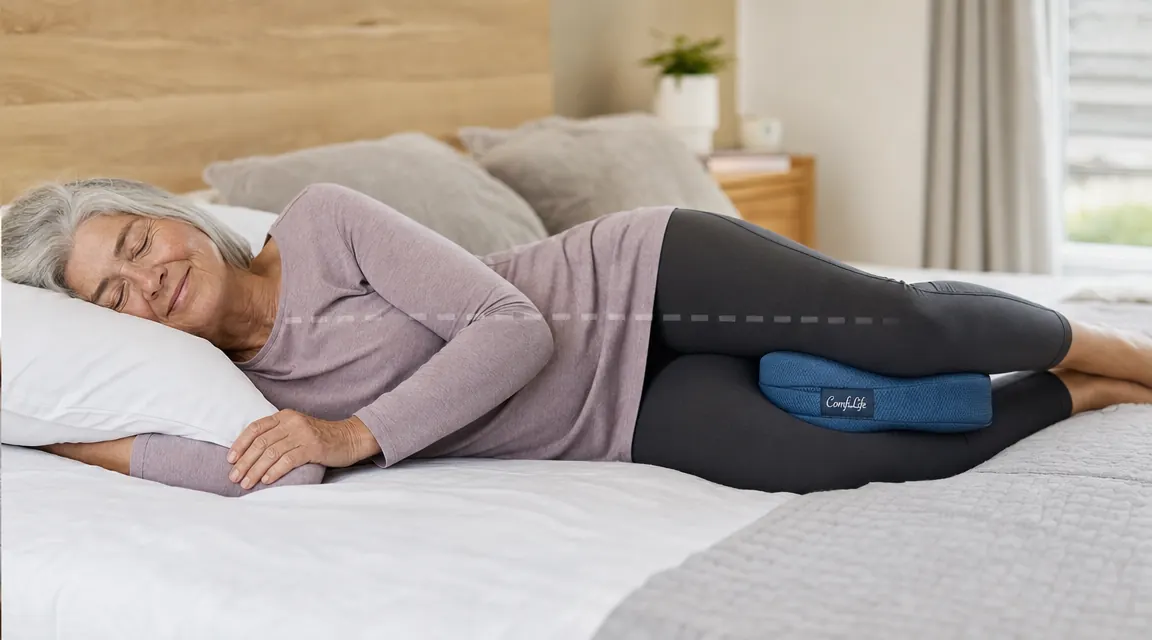
The ComfiLife orthopedic knee pillow is what I use every night. It fits between your knees and keeps your hips level so you are not putting torque on your joints while you sleep. Over 30,000 reviews on Amazon, and it costs less than a copay.
Amazon Check Today's Price on Amazon →Step 1: Put a Pillow Between Your Knees Tonight
This is the one that made the biggest difference for me, and it is also the simplest to test before spending a dime. When you sleep on your side without anything between your knees, your top leg drops forward slightly and your pelvis tilts with it. Over six or seven hours, that small tilt puts a steady wringing pressure on your hip joint and pulls at the IT band along the outside of your knee. You wake up sore and you have no idea why because the position did not feel uncomfortable when you fell asleep.
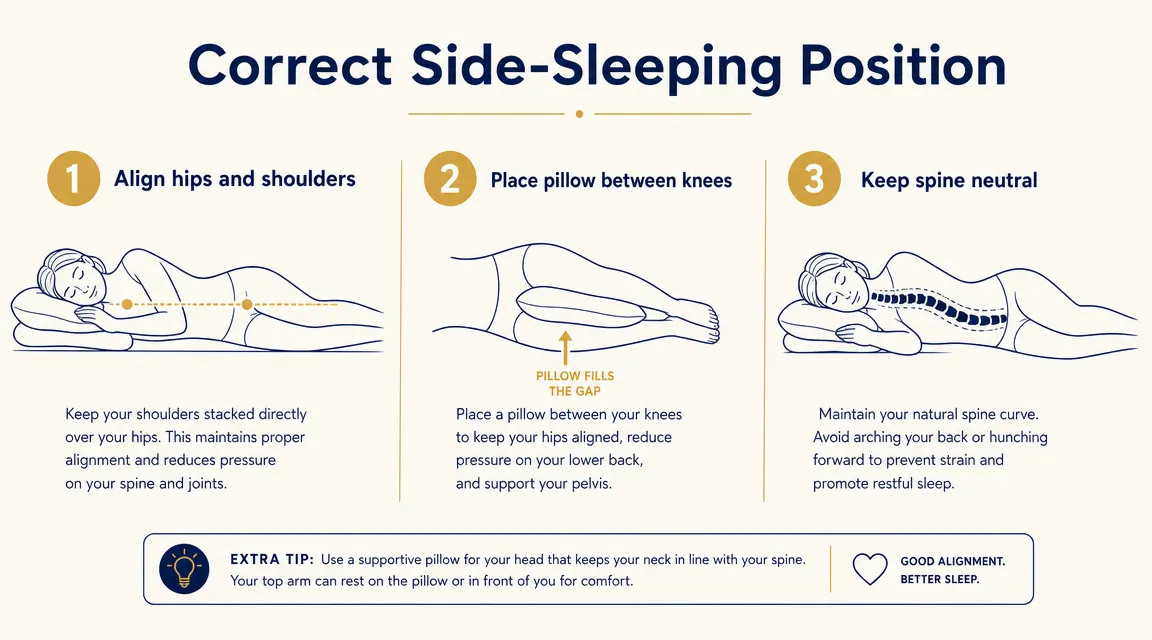
Tonight, before you buy anything, fold up a regular bed pillow and tuck it between your knees when you lie on your side. Your goal is to keep your knees about hip-width apart, which means your top knee should be level with your hip, not dropping down toward the mattress. Most people feel the difference within two or three nights. The hips stop rotating, the lower spine straightens out, and the pressure on the knees drops dramatically.
A regular pillow works as a proof-of-concept but it has real limits. It shifts around, it gets too hot, and it is too big to hold in place with your legs all night. That is why, after about a week of fighting a regular pillow, I switched to an orthopedic knee pillow shaped specifically for this purpose. The one I use is the ComfiLife orthopedic knee pillow, which has a contoured hourglass shape that grips between your knees so it stays put even when you shift positions in the middle of the night. That little design detail is what makes it so much more useful than a folded pillow.
Step 2: Check Your Mattress for Sagging in the Middle
If your mattress is more than eight years old and you sleep on the same side of the bed every night, there is a good chance your side has developed a dip or soft spot right where your hip and shoulder rest. That sag creates a hammock effect where your hip sinks lower than it should, which tilts your pelvis upward and puts your lumbar spine into an extension position all night. It is one of the most common hidden causes of morning hip and knee pain in side sleepers, and people almost never connect the two.
To check, place a rigid yardstick flat across your mattress in the area where your hip rests when you sleep. If you can see daylight between the stick and the mattress surface, you have a sag. A stopgap fix is to add a firm mattress topper on your side only. A long-term fix is a new mattress. If you are not ready for either, focus on the other steps first, but do not skip this diagnostic because it can undo everything else you try.
Step 3: Adjust the Height of Your Head Pillow
Most side sleepers use a pillow that is either too flat or too thick for their shoulder width. When your head tilts downward toward the mattress because your pillow is too thin, your neck curves and your entire spine goes slightly out of neutral from the top down. When your pillow is too thick, your head is pushed up and you get the opposite curve. Either problem creates a chain reaction that shows up as shoulder tightness, neck stiffness, and sometimes hip pain on the same side.
The right head pillow height for a side sleeper should hold your head so your nose points straight ahead, not angling up or down. If you are a broader-shouldered person you will need a thicker pillow. If you are petite you will need a thinner one. I switched to a medium-firm pillow about three inches thick and it helped my shoulder pain within a few days. I mention this because it surprised me how much the neck and hip pain were connected.
I thought my knee pain was just part of getting older. Turns out it was my sleeping position creating joint pressure for seven hours every night. Two weeks of small changes and I woke up feeling normal again.
Step 4: Switch Which Side You Sleep On Every Few Nights
Most people have a dominant sleep side, and they stay on it nearly every night. If you sleep on your right side 90 percent of the time, your right hip and right knee are bearing the load night after night with no recovery time. Alternating sides every couple of nights distributes the wear more evenly and gives your joints a chance to rest.
I know this sounds obvious but I had slept on my right side exclusively for probably thirty years. My husband says I always curl toward him, which means whatever side he is on, that is my side. Once I started consciously making myself switch and using a knee pillow on both sides, the pain on my right hip dropped off noticeably within about two weeks. Your body adapts quickly once you break the habit of always loading the same joint.

Step 5: Stretch Your Hips for Three Minutes Before Bed
When the muscles around your hip flexors and piriformis are tight from sitting during the day, they pull on the hip joint even when you are lying still. Adding a short stretch before bed loosens those muscles before they have to hold a position all night. You do not need a yoga class. Two simple stretches done gently for about ninety seconds each will do the job.
The first is a lying figure-four stretch. Lie on your back, cross your right ankle over your left knee, and gently pull both legs toward your chest until you feel a stretch in your right outer hip. Hold for thirty seconds and switch sides. The second is a knee-to-chest stretch. Still on your back, pull one knee toward your chest and hold for thirty seconds. These two moves together take about three minutes and I do them right before I pull back the covers every night. My hips go into sleep already loose, and I notice the difference when I skip even one night.
Step 6: Keep Your Knees Slightly Bent, Not Curled Tight
A lot of side sleepers curl up tight in a fetal position out of habit or for warmth. The problem is that sleeping with your knees bent sharply past about 90 degrees keeps the muscles behind the knee in a shortened position for hours at a time. That prolonged shortening leads to morning stiffness and sometimes the dull aching pain behind the knee that some people mistake for a circulation problem.
Try to sleep with your knees bent to about 45 degrees, which is a gentle curl rather than a tight one. If you tend to curl up tighter when you are cold, that is usually a warmth problem rather than a comfort preference. Adding a warmer blanket on your feet and legs often reduces the reflexive curl without any conscious effort on your part. Combine this with the knee pillow from Step 1 and you have the two structural fixes working together.
What Else Helps When You Have Tried Everything
If you have worked through all six steps and still wake up with knee or hip pain, there are two more things worth looking at. First, consider talking to your doctor about whether any inflammation in the joint itself is contributing. Knee pain during sleep can sometimes be an early sign of osteoarthritis, bursitis, or IT band syndrome, all of which benefit from physical therapy exercises that go beyond what stretching before bed can accomplish.
Second, take a closer look at what you do with your bottom arm when you sleep. A lot of side sleepers tuck their bottom arm under their pillow or under their head in a way that compresses the shoulder and rotator cuff. That compression travels down the chain and can contribute to hip misalignment. Keeping your bottom arm stretched out in front of you rather than tucked under lets your shoulder stay in a neutral position, which takes pressure off the whole kinetic chain from shoulder to hip to knee.
For more on why a knee pillow specifically is one of the highest-impact changes a side sleeper can make, I wrote a detailed piece covering the mechanics and what to look for when picking one: read my full ComfiLife knee pillow review where I cover four months of nightly use. And if you want a quick overview of the range of benefits, take a look at the 10 reasons a knee pillow helps side sleepers for a faster read on the same topic.
Ready to stop waking up sore? Start with the knee pillow
The ComfiLife knee pillow was the single biggest change in my sleep setup. The contoured shape keeps it in place all night, the memory foam is firm enough to hold your knees apart without bottoming out, and the cover is machine washable. If side sleeping has been hurting your knees or hips, this is the most practical first step you can take.
Amazon Check Today's Price on Amazon →